Web quicklinkall.blogspot.com

Saturday, November 18, 2006

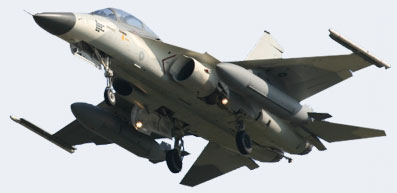
IDC F-CK Ching-Kuo

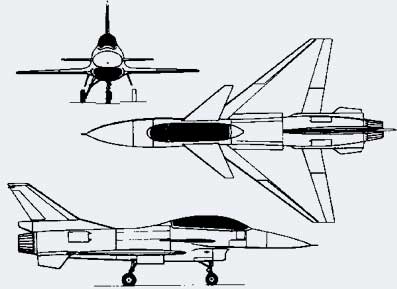
The AIDC F-CK-1 Ching-kuo is a Chinese-American light fighter aircraft that is used by, and was developed for the Republic of China (Taiwan) Air Force, it entered active service in 1994, with a total of 131 production aircraft manufactured (production ended in 1999).
It was developed as the Indigenous Defence Fighter, though it was a joint effort between Taiwanese (ROC) and U.S. Defense companies. As a result many aspects of the aircraft were influenced by F-16 Fighting Falcon, as well as F-5 (also used by the ROC). The major U.S. engineering and development subcontractors were General Dynamics (F-16 designer), Hughes, and Westinghouse Electric Corporation who worked with Taiwanese counter parts. Other parts were directly purchased from Lear Astronics (Later BAE), Litton (Later Northrop Grumman), and Martin-Baker. Final assembly was by the Aerospace Industrial Development Corporation based in Taichung, in ROC.

The IDF program started when purchase of the F-20 Tigershark ran into political problems. The preliminary search for ROCAF's F-5 and F-104 replacement began in the late 1970s. After US established formal relation with People's Republic of China and ended the Mutual Defense Treaty with Taiwan, President Chiang Ching-Kuo decided to expand the indigenous defense industry and ordered AIDC to work on an indigenous high-speed interceptor.
The IDF was designed to counter the PLA's J-8 / J-7 / newer fighters such as J-12, and was intended to have performance on par with the F-16 and Mirage 2000. The greatest difficulties were encountered by the propulsion group in attempting to develop or acquire advanced jet engines suitable for a fighter aircraft. There is also speculation that the use of weaker engines was due to political rather than technical reasons, namely that US did not want to see Taiwan to provoke PLA and thus mandated IDF to have "range no greater than F-5E" and "ground attack capability no greater than F-16".
After IDF's role changed from high-speed interceptor to air superiority fighter at the end of 1982, the engine requirements changed as well. ITEC completely redesigned TFE-1042-7 into TFE-1042-70, for example, bypass ratio was changed from 0.84 to 0.4.

In 1988, ITEC decided to invest in the 12000 lb TFE-1088-12, which was re-designated as TFE-1042-70A. Preliminary study had shown that IDF could supersonic cruise with the new engine. At the same time, GE decided to enter the market with J101/SF, a smaller version of F404. However after the IDF order was cut in half from 250 to 130 in 1992, the TFE-1088-12 engine upgrade plan ended as well. Since then, there are many rumors of AIDC completing engine upgrade research in private, but no direct public announcement of IDF fleet engine upgrade was ever made officially by either ROCAF or AIDC.

Like Tien Lei, the Tien Chien project is shrouded in secrecy. CSIST's Tien Chien is somewhat a more independent plan, since it is considered by some officials to be a development for all ROCAF aircraft rather than IDF only. Tien Chien 1 (TC-1) is a short range IR missile similar to AIM-9 external configuration. Tien Chien 2 (TC-2) is an active radar homing Beyond Visual Ranage missile claimed to be in the AIM-120 class.
The first test firing of TC-1 was made by F-5E in April 1986, with the Beech target drone successfully destroyed. Initial production of TC-1 began in 1989, and entered service in 1991. Both AIM-9 and TC-1 appeared on operational IDFs.

40 pre-production TC-2s were produced in response to the 1995-1996 Taiwan Strait Missile Crisis, as part of many emergency measures. 210 production TC-2s are planned. The production status and timeline is unknown.

After ROCAF annunced the intention to purchase F-16C/D as a stop gap measure in 2006, media widely reported that existing F-CK-1s would become trainers after new F-16s enter service. In response to a legislator's question in May 2006, Deputy Chief of the General Staff for Operations and Planning, Lt. General Cheng Shih-Yu said that Ministry of Defense indeed plans to retire F-5E/F by 2010 and let IDF to takeover the trainer missions.

General characteristics

Length: 14.21 m (46 ft 7 in)
Wingspan: 9.46 m (31 ft 0 in)
Height: 4.42 m (14 ft 6 in)
Wing area: 24.2 m² (260 ft²)
Empty weight: 6,500 kg (14,300 lb)
Loaded weight: 9,072 kg (20,000 lb)
Max takeoff weight: 12,000 kg (27,000 lb)

Powerplant:

2× TFE1042-70
Dry thrust: 27 kN (6,000 lbf)
Thrust with afterburner: 42 kN (9,500 lbf) each

Performance:
Maximum speed: Mach 1.8
Range: 1,100 km (600 nm, 680 mi)
Service ceiling: 16,800 m (55,000 ft)

Armament:
Guns: 1× 20 mm (0.787 in) M61A1 cannon
Missiles: 2× Sky Sword I , 2× Sky Sword II , Wan Chien cluster bomb

Avionics:
Radar: 1× GD-53 X-band pulse doppler

Effective scanning range:

Look down: 39 km (24 mi)
Look up: 57 km (35 mi)


Links:
www.milavia.net
www.taiwanairpower.org
www.combataircraft.com

(Adapted from http://www.wikipedia.org/ )

Labels: , , , , , , , , , , ,

JF-17 Thunder (FC-1 Fierce Dragon)

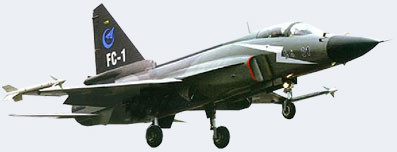
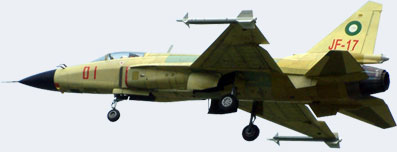
The Joint Fighter-17 (JF-17) Thunder, or Fighter China-1 (FC-1) Fierce Dragon (in China), is a single-seat multirole fighter aircraft co-developed by Pakistan and China.
The JF-17 is designed to further meet the tactical and strategic needs of the Pakistani Air Force with a minimal reliance on imports from other countries. In addition, the requirement was for the aircraft to have sufficient space for future upgrades and/or equipment specified by export buyers. The JF-17 is considered to be in the "high-tech class" of fighter aircraft.The JF-17 is being built by Chengdu Aircraft Industry Corporation (CAC)and Pakistan Aeronautical Complex (PAC). Initial reports claimed that the aircraft was based on the design of the MiG-33, a proposed single-engined version of the MiG-29, which was rejected by the Soviet Air Force. However, the FC-1/JF-17 is instead derived from the "Super Seven" project, not the Project 33 (not to be confused with the MiG-33) or the failed Chengdu J-9. Indications are that MiG assisted the program by contributing their light fighter design as well as providing additional design & development assistance.The project is expected to cost about $500 million (USD), divided equally between China and Pakistan, while each individual aircraft is expected to have a fly-away cost of $15-20 million. The project became known as JF-17 in Pakistan and FC-1 in China.

Pakistan has announced that it will procure 150 but, numbers can easily go up to 200. The JF-17 will replace the MiG-21-derived Chengdu F-7. Other countries which have expressed interest in purchasing the JF-17 are Egypt, Bangladesh, Nigeria, Burma, Zimbabwe, Morocco and Algeria.

The first prototype was rolled out on 31 May 2003, conducted its first taxi trials on 1 July, and made its first flight on 24 August of the same year. The prototype 03 made its first flight in April 2004. On April 28 2006, the prototype 04 made its first flight with fully operational avionics.
The JF-17 Thunder combat jet is a multi-role fighter-bomber and is capable of carrying multiple air-to-air and air-to-ground weapons. The fighter jet is equipped with advanced electronics and weapons systems. The ability to undertake short take-offs and landings is also incorporated in the aircraft
Not to mention the most visible change, the DSI (divergent supersonic intake).

Initially, Pakistan wanted to use the Italian Grifo-S7 radar. However, the Chinese offer had some key advantages over the Italian one, such as compatibility with Chinese weapon systems.
Radar has multiple modes, such as A2A (both BVR & close), air-to-ground, air-to-sea, etc., with strong anti-interference capacity.
It has all the standard electronic warfare systems, such as radar warning, missile approach warning, etc.
All weapon systems are designed to be compatible with both Western systems (ie. supporting MIL-STD-1760 data bus) and Russian systems (and Chinese systems also). At present, its standard missiles are the PL-9C for WVR combat and SD-10 BVRAAM for BVR combat. However, it also supports the AIM-9L/M Sidewinder, AIM-7F Sparrow. It is reported that Pakistan Air Force JF-17s will also be able to use South African air-to-air and air-to-surface munitions such as T-Darter (BVRAAM), A-Darter (WVRAAM), DPGM (Precision Guided Bomb), as well as Raptor-I and Raptor II long-range glide bombs.

Specifications JF-17 Thunder

Dimensions:
Length:
14.97 m
Wingspan: 9.46 m
Height: 4.77 m

Weights:
Empty:
6,411 kg
Loaded weight: 10,072 kg
Maximum takeoff weight: 15,474 kg
Maximum landing weight: 7,802 kg
Maximum internal fuel weight: 2,268 kg
Maximum external payload weight: 4,629 kg

Max payload (fuel and weapons): 7,063 kg

Powerplant:
Engine:
One Russian-made RD-93 turbofan, rated 89.4kN dry or 121.4kN with afterburning. The RD-93 is modified RD-33 for Chinese & Pakistani Airforce.

Performance:
Maximum Speed:
Mach 2.2
Range on internal fuel: Ferry range 2,537 km; Combat Radius ~900-1200 km
Service Ceiling: 20,500 m

Armament:
Missiles: SD-10 long-range air-to-air missile, two short-range AAMs


Links:
www.globalsecurity.org
www.pakistanidefence.com
www.sinodefence.com

(Adapted from http://www.wikipedia.org/ )

Labels: , , , , , , , , , , , ,

HAL Tejas

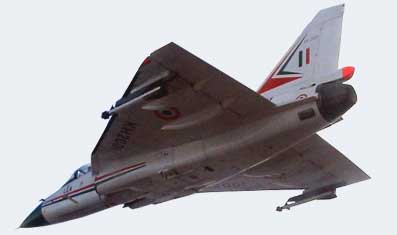
The HAL Tejas (Sanskrit: "Radiance") is a lightweight, supersonic multirole fighter aircraft being developed by India. It is a tailless, compound delta wing design powered by a single engine.

The LCA programme was launched in 1983 for two primary purposes. The principal and most obvious goal is the development of a replacement aircraft for India's ageing Mikoyan-Gurevich MiG-21 fighters. The LCA programme's other main objective is to serve as the vehicle for an across-the-board advancement of India's domestic aerospace industry.
One of the most ambitious requirements for the LCA was the specification that it would have "relaxed static stability". Most aircraft are designed with "positive" static stability, which means they have a natural tendency to return to level and controlled flight in the absence of control inputs; however, this quality tends to oppose the pilot's efforts to maneuver. An aircraft with "negative" static stability, on the other hand, will quickly depart from level and controlled flight unless the pilot constantly works to keep it in trim; while this enhances maneuverability, it is very wearing on a pilot relying on a mechanical flight control system. What made RSS practical was a new technology - the "fly-by-wire" flight control system - which employs flight computers to electronically keep the aircraft's instability in check whenever it is not desired.

Another critical technology area tackled for indigenous development by the ADA team is the Tejas' Multi-Mode Radar (MMR). It was initially planned for the LCA to use the Ericsson Microwave Systems PS-05/A I/J-band multi-function radar,[11] which was developed by Ericsson and Ferranti Defence Systems Integration for the Saab JAS-39 Gripen;[12] however, after examining other radars in the early 1990s,[13] the DRDO became confident that Indian industry was up to the challenge.

Although it had been decided early in the LCA programme to equip the prototype aircraft with the General Electric F404-GE-F2J3 afterburning turbofan engine, a parallel programme was also launched in 1986 to develop an indigenous powerplant. Being led by the Gas Turbine Research Establishment, the GTRE GTX-35VS, christened "Kaveri", was expected to replace the General Electric F404-GE-IN20 on all production aircraft. The GTRE's design envisions achieving a fan pressure ratio of 4:1 and an overall pressure ratio of 27:1, which it believes will permit the Tejas to "supercruise" (cruise supersonically without the use of the afterburner).
The Tejas is single-engined multirole fighter which features a tailless, compound delta-wing planform and is designed with "relaxed static stability" for enhanced maneuverability. Originally intended to serve as an air superiority aircraft with a secondary "dumb bomb" ground-attack role, the flexibility of this design approach has permitted a variety of guided air-to-surface and anti-shipping weapons to be integrated for more well-rounded multirole and multimission capabilities.

The tailless, compound-delta planform helps keep the Tejas small and lightweight - in fact, it is reputed to be the smallest and lightest 4th-generation combat jet in the world.[31] The use of this planform also minimises the control surfaces needed (no tailplanes or foreplanes, just a single vertical tailfin), permits carriage of a wider range of external stores, and confers better close-combat, high-speed, and high-alpha performance characteristics than comparable cruciform-wing designs. Extensive wind tunnel testing on scale models and complex computational fluid dynamics analyses have optimised the aerodynamic configuration of the LCA, giving it minimum supersonic drag, a low wing-loading, and high rates of roll and pitch.
All weapons are carried on one or more of seven hardpoints: three stations under each wing and one on the under-fuselage centreline. There is also an eighth, offset station beneath the port-side intake trunk which can carry a variety of pods (FLIR, IRST, laser rangefinder/designator, or reconnaissance), as can the centreline under-fuselage station and inboard pairs of wing stations.
The Tejas has a night vision goggles (NVG)-compatible "glass cockpit" that is dominated by an indigenous head-up display (HUD), three 5 in x 5 in multi-function displays, two Smart Standby Display Units (SSDU), and a "get-you-home" panel. Target acquisition is accomplished through a state-of-the-art radar - potentially supplemented by a laser designator pod, forward-looking infra-red (FLIR) or other opto-electronic sensors - to provide accurate target information to enhance kill probabilities. A ring laser gyro (RLG)-based inertial navigation system (INS) provides accurate navigation guidance to the pilot.

General characteristics

Length: 13.20 m (43 ft 4 in)
Wingspan: 8.20 m (26 ft 11 in)
Height: 4.40 m (14 ft 9 in)
Wing area: 38.4 m² (413 ft²)
Empty weight: 5,500 kg (12,100 lb)
Loaded weight: 8,500 kg (18,700 lb)

Powerplant:
1× General Electric F404-GE-F2J3 turbofan, 80.5 kN (18,100 lbf); or
1× General Electric F404-GE-IN20 turbofan, 83.2 kN (18,700 lbf);or
1× GTRE GTX-35VS Kaveri turbofan, 89.9 kN (20,000 lbf)

Performance:
Maximum speed: Mach 1.8, 1,920 km/h (1,195 mph) at high altitude
Range: 2000 km
Service ceiling: 15,250 m (50,000 ft)
Wing loading: 221.4 kg/m² (45.35 lb/ft²)
Thrust/weight: 1.07

Armament:
Single internally mounted 23 mm twin-barrel GSh-23 cannon with 220 rounds of ammunition.
Eight external stations:
Air-to-air missiles include Astra BVRAAM, Vympel R-77 (AA-12 Adder), and Vympel R-73 (AA-11 Archer).
Air-to-surface munitions include anti-ship missiles, laser-guided bombs, unguided bombs, cluster bombs, and unguided air-to-surface rockets.


Links:
www.combataircraft.com
www.airforce-technology.com
www.bharat-rakshak.com
www.fighter-planes.com

(Adapted from http://www.wikipedia.org/ )

Labels: , , , , , , , , , , , ,

Sunday, October 29, 2006

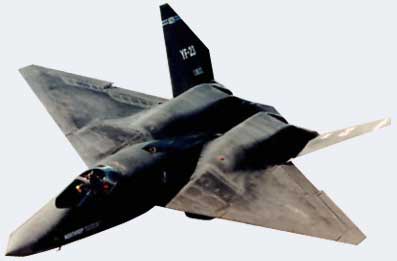
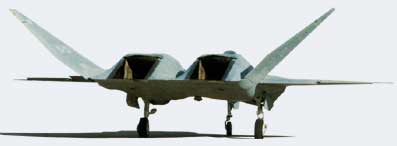
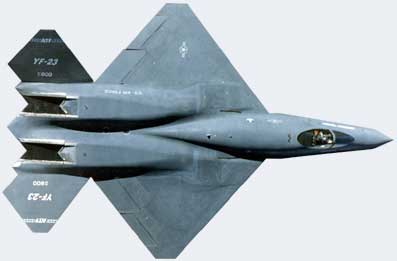
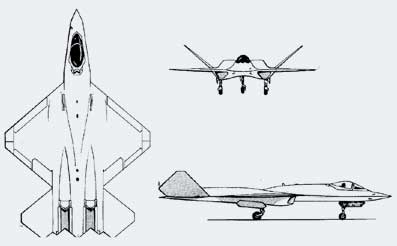
Northrop/McDonnell Douglas YF-23 Black Widow II

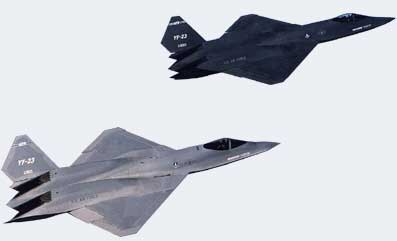
The Northrop/McDonnell Douglas YF-23 Black Widow II was a prototype fighter aircraft designed for the United States Air Force. It was passed over in favor of the YF-22 that has entered production as the F-22 Raptor.

The YF-22 and YF-23 were competing in the USAF's Advanced Tactical Fighter program. Conceived in the early 1980s, to specify a replacement for the F-15 Eagle, contracts for the two most promising designs were awarded in 1986, with the YF-23 delivered in 1989 and the evaluation concluded in 1991.
The YF-23 was designed with stealth as a high priority and was a highly unconventional-looking aircraft with diamond-shaped wings and a V-tail. The YF-23A met USAF requirements for survivability, supersonic cruise, stealth, and ease of maintenance. However, the YF-22A was more maneuverable than the YF-23A and won the competition in April 1991.
Although the precise results of the evaluation are not yet public knowledge, it is often claimed that the YF-23 was faster and stealthier than its competitor, but the USAF chose the YF-22 due to ease of production, maintenance, and potential for future development, as well as its relatively lower production cost. On the other hand, some say that the YF-22 was chosen for its superior subsonic maneuverability due to thrust vectoring. Others point out the YF-23's comparatively flawed weapons release mechanism wherein missiles are stacked on racks, and a weapons jam of a lower-positioned missile could prevent the firing of the missile above it.

Two aircraft were built. After losing the competition, both YF-23 prototypes were transferred from Northrop to NASA's Dryden Flight Center, at Edwards AFB, California.
Aircraft PAV-2 is now an exhibit at the Western Museum of Flight in Hawthorne, California and PAV-1 was recently moved to the National Museum of the United States Air Force, where it sits along side the Boeing X-32 in one of the Museum's restoration hangars awaiting restoration for display.

In late 2004, Northrop Grumman proposed a YF-23 based design for the USAF's interim bomber requirement, a role for which the FB-22 and B-1R are also competing. The interim bomber requirement has since been cancelled in favor of a more long-term, permament bomber replacement requirement; however, the same YF-23-derived design will likely be adapted to fulfill this role as well.

Specifications

Length: 67 ft 5 in (20.60 m)
Wingspan: 43 ft 7 in (13.30 m)
Height: 13 ft 11 in (4.30 m)
Wing area: 948 ft² (88m²)
Empty weight: 32,934 lb (14,970 kg)
Loaded weight: 51,320 lb (23,327 kg)
Max takeoff weight: 64,000 lb (29,029 kg)

Powerplant:

2× General Electric YF120 or Pratt & Whitney YF119 turbofan, 35,000 lbf (277 kN)

Performance:
Maximum speed: 1,400 mph (2,240 km/h)
Combat radius: 921 miles (1,474 km)
Service ceiling: 65,000 ft (19,800 m)
Wing loading: 54 lb/ft² (265 kg/m²)
Thrust/weight: 1.4

Armament:
1× 20 mm M61 Vulcan cannon
6× air-to-air missiles, including the AIM-120 AMRAAM and AIM-9 Sidewinder


Links:
www.fas.org
www.voodoo.cz
www.globalaircraft.org
www.dreamlandresort.com

(Adapted from http://www.wikipedia.org/ )

Labels: , , , , , , , , , , , , ,

BAC TSR-2

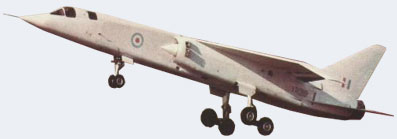
The British Aircraft Corporation's TSR-2 was an ill-fated Cold War project in the early 1960s to create what would, at that time, have been one of the most advanced aircraft in the world.

In the 1950s, the British Royal Air Force was aware that the Canberra bomber would need to be replaced, and a specification for its replacement with additional strike and reconnaissance roles was drafted in the form of GOR (General Operational Requirement) 339 in 1956. This specification was exceptionally ambitious for the technology of the day, requiring a supersonic all-weather aircraft that could deliver nuclear weapons over a long range, operate at high level (at Mach 2+) or low level (at Mach 1.2), with a short takeoff ability from rough and ready airstrips.

The envisioned "standard mission" for the TSR-2 was to carry a 2,000 lb (900 kg) weapon internally for a combat radius of 1,000 nautical miles (nm) (1,852 km). Of that mission 100 nm (185 km) was to be flown at higher altitudes at Mach 1.7 and the 200 nm (370 km) into and out of the target area was to be flown as low as 200 feet (60 m) at Mach 0.95. The rest of the mission was to be flown at Mach 0.92. If the entire mission were to be flown at the low 200-foot altitude, the mission radius was reduced to 700 nm (1300 km). Heavier weapons loads could be carried with further reductions in range.
The design was a large aircraft with large shoulder mounted slab-wing with down-turned tips, all-moving swept tailplane, a large all-moving fin. powered by two Bristol-Siddeley Olympus afterburning turbojets. The latter were a variant of those used in the Avro Vulcan and Concorde.

The design featured blown flaps to achieve the short take off and landing requirement, something which later designs would achieve with the technically more complex swing-wing approach. The aircraft featured some extremely sophisticated avionics for navigation and mission delivery which was also to be one of the reasons for the spiralling costs of the project. Some features, such as ground-following terrain radar, FLIR cameras, side-looking airborne radar and the sophisticated autopilot did only become commonplace on military aircraft later. The wing loading was high for its time, and this gave the aircraft the ability to fly at very high speed and low level with great stability without being constantly upset by thermals and other ground-related weather phenomena. This in turn made the innovative ground-following radar and autopilot system feasible.

Despite the rocketing costs, two prototype aircraft were completed. In testing the TSR-2 was found to easily meet the demanding performance specification. Aerodynamically the aircraft was trouble-free, but there were continual problems with the engines and the undercarriage. Initial flight tests were all performed with the undercarriage down and engine power strictly limited.

The first supersonic test flight, the fourteenth overall, had to be performed with only one afterburner due to problems with one of the engines. A speed of Mach 1.2 was reached on that occasion.
The American team behind the General Dynamics F-111 project had been pressing their case and newspaper reports had suggested that the RAF were considering it. In the next year budget speech , the cancellation in favour of the F-111 was announced.
Instead of the TSR-2, the RAF decided it would buy the swing-wing American General Dynamics F-111 - however, the F-111 itself suffered such enormous cost escalation (exceeding that of the TSR-2 projection ) that the RAF eventually cancelled their order, procuring instead the F-4 Phantom II and the Blackburn Buccaneer.

Estimated Specifications

Dimensions:
Length: 89 ft ½ in (27.12 m)
Wingspan: 37 ft 1¾ in (11.27 m)
Height: 23 ft 9 in (7.24 m)
Wing area: 702.9 ft² (65.3 m²)

Weights:
Empty 54,750 lb (24,834 kg)
Loaded 79,573 lb lb (36,169 kg)
Maximum takeoff 102,200 lb (46,357 kg)

Powerplant:
Engines 2× Bristol-Siddeley Olympus B.O1.22R
Thrust 2× 30,610 lbf (2× 136.7 kN)

Performance:
Maximum speed: Mach 2.15
Combat range: 1150 miles (1850 km)
Ferry range: 4256 miles (6850 km)
Service ceiling: 54,000 ft (16,459 m)
Rate of climb: 50,000 ft/min (16,000 m/min)

Armament:
Payload Internal weapons bay, 20 ft (6 m) with 1 nuclear or 6 x 1000 lb (450 kg) HE, or 4 x 37 rocket packs or nuclears on inner pylons only.


Links:
www.thunder-and-lightnings.co.uk
www.historyofwar.org
www.unrealaircraft.com

(Adapted from http://www.wikipedia.org/ )

Labels: , , , , , , , , , , , , , ,

IAI Kfir

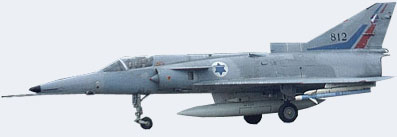
Israel Aircraft Industries Kfir is an Israeli-built all-weather, multi-role combat aircraft based on a modified Dassault Mirage 5 airframe, with Israeli avionics and an Israeli-made version of the General Electric J79 turbojet engine.The IAI Kfir is one of the best known examples of the developmental approach to the design and construction of combat aircraft, which consists in the modernization of well-proven airframes to face the challenges posed by an increasingly sophisticated air-combat environment.The project that would ultimately give birth to the Kfir can be traced back to Israel's need for adapting the Dassault Mirage IIIC to the specific requirements of the Israeli Air Force (IAF).
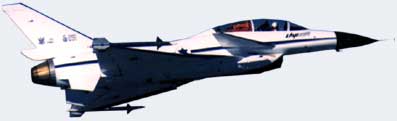
While the Mirage IIICJ proved to be extremely effective in the air-superiority role, its relatively short range of action imposed some drawbacks to its usefulness as a ground-attack aircraft.
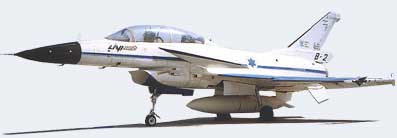
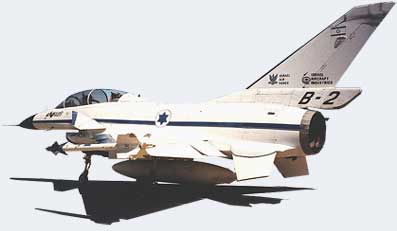
Thus, in the mid-1960s, at the request of Israel, Dassault Aviation began developing the Mirage 5, a fair-weather, ground-attack version of the Mirage III. By 1968, Dassault had finished production of the 50 Mirage 5Js paid for by Israel, but an arms embargo imposed upon this country by the French government in 1967 prevented Dassault from ever delivering the aircraft. The Israelis replied by producing an unlicensed copy of the Mirage 5, the Nesher (Eagle), with technical specifications for both the airframe and the engine obtained by the Israeli intelligence.

In order to accommodate the General Electric J79 powerplant on the Mirage III's airframe, and to deliver the added cooling required by the J79, the aircraft's rear fuselage was slightly shortened and widened, its air intakes were enlarged, and a large air inlet was installed at the base of the fin, so as to supply the extra cooling needed for the afterburner. The engine itself was encased in a titanium heatshield.
When the Kfirs were modified to use small detachable canards and other minor improvements, they were given the name Kfir C.1.

The much improved Kfir C.2, revealed in 1976, was the first full-standard version of the aircraft. Benefiting from the operational experience obtained with the first variant, the C.2 featured delta canard foreplanes mounted on the air intakes, narrow "strakes" along the tip of the nose, and extended "dogtooth" outer wing panels. These aerodynamic modifications gave the Kfir better all-around manoeuvrability, reduced landing and take-off distance, and superior handling at low speeds. All C.2s were also equipped with a Martin-Baker Mk.10 ejection seat, and seven weapons pylons.
In 1983, IAI began to upgrade the Kfir C.2s/TC.2s to a new variant, the Kfir C.7/TC.7, which carried a modified version of the J79-GE-17E powerplant, with an additional 4.45 kN (1,000 lb st) of afterburning thrust, and an enhanced thrust-to-weight ratio. The Kfir C.7 featured a modernized HOTAS cockpit, with new avionics, including the Elta EL/M-2021B pulse-Doppler radar and the Elta EL/L-8202 advanced electronic jammer, plus guided weapons carrying capability, two additional hardpoints below the intake ducts (for a total of nine), and provision for in-flight refueling. With a maximum take-off weight increased by 1,540 kg (3,395 lb), as well as an improved combat radius, the Kfir C.7 was a much better ground attack aircraft than its predecessor. The emphasis given on the improvement of the strike capabilities of the Kfir signaled the new role assigned to the aircraft in the IAF's order or battle during the 1980s, as the F-15s and F-16s took over the air-superiority and interception missions.

Since the J79 turbojet engine as well as much of the technology inside the Kfir are produced in Israel under U.S. license, all export sales of the Kfir are subject to prior approval from the U.S. State Department, a fact that has limited the sale of the Kfir to foreign nations.
As of 2006, the IAI Kfir has been exported to Colombia, Ecuador, and Sri Lanka. Also, 25 Kfir C.1s were leased to the US Navy and the USMC in the 1980s.

Specifications (Kfir C.2)

Length: 15.65 m (51 ft 4.25 in)
Wingspan: 8.21 m (26 ft 11.5 in)
Height: 4.55 m (14 ft 11.5 in)
Wing area: 34.80 m² (374.60 sq ft)
Empty weight: 7,285 kg (16,060 lb)
Loaded weight: 10,415 kg (22,961 lb)
Max takeoff weight: 14,670 kg (32,340 lb)

Powerplant:
1× IAl Bedek-built General Electric J-79-J1E turbojet
Dry thrust: 52.89 kN (11,890 lb st)
Thrust with afterburner: 83.40 kN (18,750 lb st)

Performance:
Maximum speed: 2,440 km/h (1,516 mph)
Range: 770 km (480 mi)
Service ceiling: 17,700 m (58,000 ft)
Rate of climb: 233.3 m/s (45,930 ft/min)

Armament:
Guns: 2x Rafael-built DEFA 553 30-mm cannons with 140 rounds per gun.
Maximum Ordnance Load: 6,065 kg (13,343 lb)
Bombs: Mk-82, GBU-13 LGB, TAL-1 and TAL-2 CBUs, BLU-107 Durandal, HOBOS.
Unguided rocket launchers
Missiles: Shrike ARMs; Maverick ASMs; Sidewinder, Shafrir, and Python-series AAMs.

Links:
www.israeli-weapons.com
www.globalaircraft.org
www.fas.org
www.acig.org


(Adapted from http://www.wikipedia.org/ )

Labels: , , , , , , , , , , , , , , , ,

Friday, October 06, 2006

Chengdu J-10

The Chengdu J-10 is a multirole fighter aircraft designed in collaboration with Israel Aircraft Industries and produced by the People's Republic of China Chengdu Aircraft Industry Corporation” (CAC).
The program was conceived in the early 1980s, to counter new fourth generation fighters then being introduced by the USSR (namely, the MiG-29 and Su-27)

Initially designed as a specialized counter-air fighter, it was later remade into a multirole aircraft capable of both anti-air combat and ground attack missions. It has been argued that the J-10 is based on the now cancelled Israeli Lavi.
Having been designed under much secrecy, many details of the J-10 remain unknown and are subject to much speculation. The first flight of the J-10 took place sometime in 1996, but the program suffered a major delay due to a fatal accident which occurred in 1997. This incident was thought to be the result of errors in the J-10’s fly-by-wire system. (Note, there is evidence, albeit non-conclusive, that only one prototype was flying; the other was a ground static testbed. Hence, no crash occurred.) A redesigned prototype flew in 1998, resuming flight testing of the aircraft. Service entry into the PLAAF occurred in late 2005.

The J-10 is a single-seat, delta winged aircraft powered by a single, Russian-designed AL-31FN turbofan (maximum static power output of 12,500 kgf (123 kN, 27,600 lbf)). The airframe possesses a large vertical tail, as well as canards placed near the cockpit. The air intake is rectangular in shape, and is located beneath the fuselage. Construction likely incorporates much use of composite materials, as well as more conventional metals. Performance is generally speculated to be within the class of a late-model F-16, although maneuverability is thought to be superior (possibly within the range of some early fifth generation Western fighters). A bubble canopy provides 360 degrees of visual coverage for the pilot.
It was reported in November 2005 that a first batch of AL-31FN thrust vectoring engines had already been received from Russia for use in J-10s. A second batch was supposed to arrive later that year, and the rest would arrive by mid-2006. On 9 January 2006, it was claimed that these new engines were actually termed AL-31FN M1, and would be used in a new advanced version of the J-10 called the "Super-10". Regardless of how they are eventually used, thrust vectoring will boost the J-10's maneuverability.
China has made progress toward development of it own WS-10A 'Taihang' turbofan engine. There are plans to produce future variants of J-10 and J-11 using WS-10A engine.

A digital, quadruplex fly-by-wire system aids the pilot in flying the aircraft. Information is provided visually to the pilot, in the form of three liquid crystal Multi-Functional Displays within the cockpit. Western-style HOTAS (Hands On Throttle And Stick) controls are incorporated in the J-10's design.
The radar type equipping the J-10 is not yet known; possible candidates include the Russian RP-35, the Israeli EL/M-2035, the Italian Grifo 2000 and the domestic JL-10A. A comprehensive ECM (Electronic countermeasures) package is likely to be present, including active jammers.

It was reported by Jane's Defence Weekly on 9 January 2006, that a more advanced version of the J-10 is planned, "referred to as the Super-10, with a more powerful engine, thrust-vector control, stronger airframe and passive phased-array radar"
So far the J-10 has been offered only to Pakistan for export as the F-10.
On April 12, 2006 the Pakistani cabinet approved the purchase of at least 36 J-10s under the designation FC-10.
The wings provide 11 hardpoints for the attachment of up to 4,500 kg (9,900 lb) of weaponry, fuel tanks, and ECM equipment. Built-in armament consists of a 23 mm cannon, located within the fuselage. External weaponry may include: short-range infrared air-to-air missiles (Chinese PL-8, or the Russian R-73), medium-range radar-guided air-to-air missiles (Chinese PL-11 and PL-12, or the Russian R-77), laser-guided and un-guided bombs, anti-ship missiles (Chinese YJ-9K), and anti-radiation missiles (YJ-9).

Estimated Specifications

Length: 14.57 m (47 ft 10 in)
Wingspan: 8.78 m (28 ft 9 in)
Height: 4.80 m (15 ft 9 in)
Wing area: 33 m² (360 ft²)
Empty weight: 9,750 kg (21,500 lb[4])
Max takeoff weight: 18,400 kg (40,600 lb)


Powerplant:

1× Lyulka-Saturn AL-31FN turbofan
Dry thrust: 79.43 kN (17,860 lbf)
Thrust with afterburner: 123 kN (27,600 lbf)

Performance:
Maximum speed: Mach 2.0 (2,450 km/h, 1,520 mph) at altitude
g-Limits: +9/-3 g (+88/-29 m/s², +290/-97 ft/s²
Combat radius: 550 km (300 nm, 340 mi)
Maximum range: 1,850 km (1,000 nm, 1,150 mi)
Service ceiling: 18,000 m (59,000 ft)
Minimum thrust/weight With afterburner: 0.68

Armament:
Guns: 1× 23 mm internal cannon
Hardpoints: 11, 3 under each wing and 5 under the fuselage
Missiles:
Air-to-air: PL-8, PL-11, PL-12, R-73, R-77
Air-to-surface: YJ-9, YJ-9K
Bombs: laser-guided bombs, unguided bombs


Links:
www.aeronautics.ru
www.milavia.net
www.globalsecurity.org
www.sinodefence.com (Adapted from http://www.wikipedia.org/ )

Labels: , , , , , , , , , , , , , , , , ,

IAI Lavi

The IAI Lavi (lion cub in Hebrew) was a multi billion dollar project that was allegedly disbanded under preasure from the US Governmant.
The prototype fighter jet developed was put on display for photographers and was never heard of or spoken about again.

The project began in February 1980, when the Israeli government authorized the IAF to present it with a list of technical specifications for the development of the IAF's future fighter. The development stage began in October 1982, with the choice of a Pratt & Whitney engine already having been made.
One of the Lavi's most distinct advantages is its functional features, especially its cockpit, custom-built entirely using input from active IAF fighter pilots. Drawing on their operational experience, the design was geared to let the pilot handle the tactical aspects of the battle, without having to worry about monitoring and controlling the various subsystems. The avionics of the Lavi were considered to be innovative and groundbreaking, and included self-analysis equipment to make maintenance easier.

On December 31, 1986, the first prototype of the plane took off on its maiden flight. The test pilot, Menachem Shimol, head of IAI's Air Operations section, took off at 13:21 and stayed in the air for 26 minutes, during which he checked the engine and controls.
About three months later, a second prototype took to the air. In its maiden flight, the engine systems, flight control, electrical system, hydraulics and air conditioning were evaluated. The second prototype had some improvements over the first, with a belly-mounted fuel tank, a special midair refuelling pipe and several avionic systems that were not employed in the first prototype.

The IAI had produced three prototypes out of the originally-planned five when the Israeli government decided to cancel the project because of budget problems and bickering among various economic and political pressure groups. The total cost for the development and production of the Lavi was $6.4 billion U.S. in 1983, around 40 percent of which was paid by the U.S. government. The project was canceled in part because the U.S. was not prepared to finance an aircraft that would compete in the export market with the F-16C/D and the F/A-18C/D, and also because a dispute arose as to the final cost. The Israeli government was unable to finance the project alone and canceled it on August 30, 1987. The decision to cancel was approved with a majority of only one vote.

Specifications

General characteristics:
Length: 14.57 m (47 ft 10 in)
Wingspan: 8.78 m (28 ft 10 in)
Height: 4.78 m (15 ft 8 in)
Wing area: 33.0 m² (355 ft²)
Empty weight: 7,031 kg (15,500 lb)
Loaded weight: 9,991 kg (22,025 lb)
Max takeoff weight: 19,277 kg (42,500 lb)

Powerplant:
1× Pratt & Whitney PW1120 afterburning turbofan, 91.5 kN (20,600 lbf)

Performance:
Maximum speed: 1,965 km/h (1,220 mph)
Range: 3,700 km (2,300 mi)
Service ceiling: 15,240 m (50,000 ft)
Rate of climb: 254 m/s (50,000 ft/min)
Thrust/weight: 0.94

Armament:
1x 30 mm DEFA cannon
7,260 kg (16,000 lb)

Links:
www.aerospaceweb.org
aircraftstories.free.fr
www.geocities.com/TimesSquare/Cavern/6130/iafm_lavi.htm
www.combatsim.com

(Adapted from http://www.wikipedia.org/ )

Labels: , , , , , , , , , , , , , ,

Saturday, September 23, 2006

Sukhoi Su-24 'Fencer'

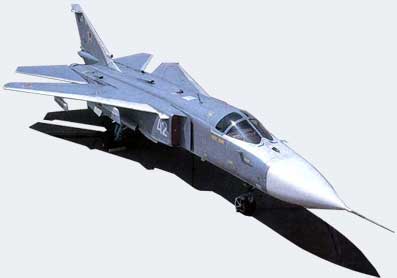
The Sukhoi Su-24 (NATO reporting name Fencer) emerged from an early 1960s specification for a new attack bomber to replace the Ilyushin Il-28 and Yakovlev Yak-28. The specification called for an all-weather aircraft capable of supersonic speed at low level, with a very high standard of navigational and bombing accuracy and a excellent short-field performance.
A solution was variable geometry, also being applied to the roughly contemporary Sukhoi Su-17 and Mikoyan-Gurevich 23-11. The second Sukhoi prototype was fitted with a variable wing, redesignated T-6-2IG. This first flew in 1970, and proved to be successful enough to merit production, initially under a cover designation of Su-15M .

The Su-24 evolved through several early variations, each earning separate NATO reporting names.
The Su-24M finally entered service in 1983. Two specialized versions, the Su-24MR ('Fencer-E') reconnaissance variant and the Su-24MP ('Fencer-F') ELINT gatherer, were developed from the Su-24M.

The Soviets used some Su-24s in Afghanistan in 1984, and the 'Fencer' saw combat service again in the Chechen conflicts of the 1990s. Its bombing accuracy in the latter conflict has been criticized, because while the Su-24 apparently performed within its original design parameters, there were large numbers of civilian casualties and collateral damage.
An export version of the Su-24M, the Su-24MK, has been sold to several foreign customers. Ten were sold to Algeria, 15 to Libya, and 12 to Syria. A total of 32-33 Su-24MKs were sold to the Islamic Republic of Iran Air Force and to Iraq, but sources differ on the specific numbers. Russian sources claim that nine were sold to Iran and 24 to Iraq, all of which are now operated by Iran. Iran claims it purchased 14 and gained 16-18 ex-Iraqi aircraft that fled Iraq to escape destruction in the 1991 Gulf War.
About 1,200 Su-24s were produced. Substantial numbers of Ex-Soviet Su-24s remain in service with Azerbaijan, Belarus, Kazakhstan, Russia, Uzbekistan and Ukraine. Roughly 577 are currently operational with Russian forces, split 447 with the Russian Air Force and 130 with the Russian Navy.
Although a formidable warplane in its day (albeit not quite as much so as initially believed by the West), the 'Fencer' is likely to be replaced by the Su-27IB/Su-32FN/Su-34 or other more advanced aircraft as Russian finances permit.

The Su-24 is aerodynamically similar to the contemporary MiG-23 'Flogger,' although it is substantially larger. It has a shoulder-mounted variable geometry wing outboard of a relatively small fixed wing glove, swept at 69°. The wing has four sweep settings: 16° for take-off and landing, 35° and 45° for cruise at different altitudes, and 69° for minimum aspect ratio and wing area in low-level dashes. The variable geometry wing provides excellent STOL performance, allowing a landing speed of 230 km/h (143 mph), even lower than the Su-17 despite substantially greater take-off weight. Its high wing loading provides a stable low-level ride and minimal gust response, but reportedly makes the aircraft somewhat difficult to fly. The Su-24 can be unforgiving under some circumstances.

The Su-24 seats two, a pilot and a weapon systems officer, in side-by-side cockpit (similar to the F-111). The avionics were the most sophisticated in Soviet use, with the USSR's first integrated, and computerized nav/attack system. The early Su-24s carried separate attack and terrain-avoidance radars, along with a Doppler navigation set.
The Su-24's fixed armament is a single fast-firing GSh-6-23 cannon with 500 rounds of ammunition, mounted in the fuselage underside. Unlike the MiG-27's external cannon gondola, the 'Fencer' installation of this weapon covers the gun with an eyelid shutter when not in use. There are eight external hardpoints (two under the inner wing glove, two swiveling pylons under the outer wing, and four on the fuselage) for a maximum warload of 8,000 kg (17,600 lb), including various nuclear weapons. Two or four R-60 (NATO AA-8 'Aphid') infrared missiles are usually carried for self-defense.

The Su-24 has often been compared to the American F-111, but despite being close to the F-111 in size, it never matched the USAF aircraft's range or load-carrying ability. Its true capabilities are closer to those of the smaller Panavia Tornado, although its less-efficient engines make the 'Fencer's' range somewhat shorter.

An upgraded 'Fencer' began development in the mid-1970s and entered service around 1983, has a 0.76 m (30 in) longer fuselage section forward of the cockpit, adding a retractable inflight refueling probe, and a reshaped, shorter radome for the new 'Orion-A' attack radar. It can be identified by the single nose probe in place of the three-part probe of earlier aircraft. The new radar was coupled with a Relyef terrain-following radar coupled with SAU-6M1 automatic flight control system, allowing automatic ("hands-off") low-level flight. A new PNS-24M inertial navigation system and digital computer were also added. A Kaira 24 laser designator/TV system (similar to the American Pave Tack) was fitted in a bulge in the port side of the lower fuselage for compatibility with guided weapons, including laser-guided bombs and TV-guided bombs, and Kh-14 (AS-12 'Kegler') and Kh-59 (AS-13 'Kingbolt') missiles, as well as unguided bombs and rockets. The new systems led to a reduction in internal fuel amounting to 85 litres (22.4 US gallons).


Specifications (Su-24M)

General characteristics:

Length: 22.67 m (80 ft 6 in)
Wingspan: 17.63 m extended, 10.36 m maximum sweep (57 ft 10 in / 34 ft 0 in)
Height: 6.19 m (20 ft 3 in)
Wing area: 55.2 m² (594 ft²)
Empty weight: 22,300 kg (49,160 lb)
Loaded weight: 35,910 kg (79,170 lb)
Max takeoff weight: 39,700 kg (87,500 lb)

Powerplant:

Saturn/Lyulka AL-21F-3A turbojets, 75 kN dry, 110 kN afterburning (16,900 lbf / 24,700 lbf) each

Performance:
Maximum speed: Mach 1.1, 1,340 km/h at sea level; 1,550 km/h at high altitude (830 mph / 960 mph)
Range: 560 km in a lo-lo-lo attack mission with 3,000 kg ordnance and external tanks; 2,500 km ferry (350 mi / 1,550 mi)
Service ceiling: 11,000 m (36,100 ft)
Rate of climb: 150 m/s (29,500 ft/min)
Wing loading: 651 kg/m² (133 lb/ft²)
Thrust/weight: 0.62

Armament:
1x GSh-6-23 cannon
4 Kh-23 (AS-7 'Kerry') radio-command missiles
4 Kh-25ML (AS-10 'Karen') laser-guided missiles;
2 Kh-28 (AS-9 'Kyle'), Kh-58 (AS-11 'Kilter'), or Kh-31P (AS-17 'Krypton') anti-radiation missiles;
3 Kh-29L/T (AS-14 'Kedge') laser/TV-guided missiles;
2 Kh-59 (AS-13 'Kingbolt') TV-command guided missiles, or KAB-500KR TV-guided and KAB-500L laser-guided bombs.
Standard rocket launchers with 55 mm S-5 rockets, 80 mm S-8 rockets, or 120 mm S-13 rockets
Other weapon options include general-purpose bombs, external gun pods, and tactical nuclear bombs.
Two R-60 (AA-8 'Aphid') air-to-air missiles are normally carried for self-defense; upgrade aircraft can carry R-73 (AA-11 'Archer') as well.


Links:
www.combatavia.info
www.airwar.ru
www.aviacia.ru
www.suchoj.com

(Adapted from http://www.wikipedia.org/ )

Labels: , , , , , , , , , , , , , , , ,